
Happy New Year! I guess?
Welcome to the first lift to ground newsletter of 2025. I'm so happy you're here.
I'm using a new format. Mostly because the platform I pay for each month has the feature, and I want to try it out. And I want to know if you like it, so please feel free to let me know your thoughts, especially if you hate it. 🥲
My year got off to a rough start. A few days after Christmas I got sick (and stayed sick for three weeks, eek), and a week later I drove back to Colorado from New York.
I spent the first couple weeks of January feeling deeply disconnected from my body, and like I was in limbo just waiting to feel better. I'm happy to say I feel pretty much back to baseline now (grateful) but feeling so sick for weeks brought up some thoughts.
Thoughts which will lead me to January's loose rule of life and lifting:
Check in with your weekly cumulative load.
The fresh energy of a new year, even a new month, usually excites and inspires me. And this year was no different! But when I reflect on the years I tried to overhaul, reinvent, and rebrand myself into someone (something?) unrecognizable, I feel comforted by how far I've come.
Nature tells us to prioritize rest in colder seasons. Winter signals us to look toward recovery and nourishment. And this doesn't mean you shouldn't be active or take care of yourself. To me, it begs the question:
Why not include rest, recovery, slowing down and seeking ease in our New Year's goals?
When I talk about cumulative load with clients and students, I say something like, "your cumulative load is the sum of all your stressors piled on top of each other as the week goes on." I like framing ideas in weekly terms, but this applies to time in general: cumulative load is stress in the aggregate.
Many of us in the fitness world use the word "load" to describe training volume, which describes the total work done during a workout, e.g. the sets x reps x weight you use in a strength session.
Expanding your interpretation of "load" means you also consider the less-tangible weight you're lifting. Maybe you're working to reach a work deadline. Maybe you're experiencing grief, pain or illness. Maybe the collective weight of the world is adding up for you.
This additional load could also be quantifiable, like extra hours you're spending working. But whether you can count it all up or not, taking additional (whether positive, neutral or negative) stressors into account can be helpful in planning your workouts and making decisions that serve your well-being.
So how do you take all this into account to plan your workouts? The good news: that depends on you. The not-so-good news: that depends on you. :) The great news: the more you do this accounting for, the better you'll get at it, and the easier it will become. Start here:
Step 1: Identify Your Stressors (positive, neutral and negative)
My list would include: strength workouts, skiing, houseparenting, work stress, business-owner/entrepreneurship stress, financial stress, etc. Write them down. It might feel weird.
Step 2: Gauge Your Stress This Week
I'm not one for getting really detailed with this kind of thing. Considering the brands of stressor you've identified in Step 1, think about what the bigtime Stressors of The Week will be. Maybe there's a specific work event coming up, maybe you're hosting a birthday party or giving a presentation. In addition to outlining the stressy heavy-hitters, take a look at your schedule for the week.
Step 3: Scale and Schedule Your Weekly Workouts
Great work on first steps! You're probably overwhelmed now. Allow me to validate the discomfort of actually evaluating your own levels of stress and auditing your week. We're almost there, walk with me.
Anticipating what will stress you out the most this week, and while looking at your calendar, schedule your workouts with these two simple questions in mind:
- How many workouts make sense this week, and for how long?
- Remember that frequency and duration of your workouts are variables you get to control, as well as training volume inside of your workouts. Make adjustments to lighten or increase your load over the course of the week.
- When can I (actually) make the time for workouts?
- Honesty is the best policy. Be brutal.

Now is a good time to consider the stress-reducing impact of movement. While exercise contributes to your weekly cumulative load, it can also be an outlet and release for other stressors. :)
When I say "schedule," I don't mean pencil them in.
If you know me, you know I consider perfection and consistency to be basically opposites. To me, adjusting and modifying workouts in response to how your body shows up for a workout is a given. But one piece of advice I often give to clients who need help getting workouts done is this: to consider weekly workouts equally as important as your other meetings, obligations and duties. Even when another part of your life has to be the priority, starting with the understanding that working out is just as important as all the other ways you show up for yourself and others teaches your brain to prioritize training.
And where your mind goes, your body will probably follow. Getting honest with yourself might feel a little clunky, and you might feel some resistance. That's totally expected! Keep in mind that you're making the effort to better serve your well-being, to have more energy and to make the most of your training!
January's g.r.o.u.n.d.i.n.g.
As a reminder, g.r.o.u.n.d.i.n.g. is a monthly roundup of the following:
- growing: tools I'm using to work on myself
- reading: books, articles, etc that I'd love to share with you
- offering: reminding you about my business offers, both evergreen and upcoming :)
- unlearning: lessons I think are worth sharing
- nourishing: food strategies and recipes that keep me feeling good
- discovering: new fun stuff I've found, from music to I don't even know what, you've been warned
- improving: sharing progress toward my personal goals!
- nurturing: self-care tools I'm leaning on, or things in life I'm prioritizing
- giggling: what is life without laughter? funny stuff and stories
growing: I'm excited to share that I recently completed a Scientific Back Training course with the Chek Institute. I also recently enrolled in the Trauma Informed Weightlifting Certificate Program and I'm really looking forward to starting this week!
reading: I just finished Loud: Accept Nothing Less than the Life You Deserve by Drew Afualo. Her memoir blends her personal stories with perspectives on patriarchy, white supremacy and fatphobia that will not only stick with me, but help me to teach the concepts of these systems to others. I'm also currently reading Anchored: How to Befriend Your Nervous System Using Polyvagal Theory by Deb Dana. I enjoy studying and learning about the nervous system, trauma, and how we can understand how we feel in our bodies, and I've learned so much only a few chapters in. Looking forward to sharing more!
Two newsletter editions of note I've read in the last couple of months:
From Dr. Ayesha Khan's Cosmic Anarchy: Is our fixation on healing, self-care & self-improvement making us sicker?
From Snaxshot: Pendulum Swung Back Hard: MAHA, gluten matters, holistic himbos
offering: I'm about at capacity for both online fitness coaching and virtual personal training, but I'll send updates on current offers your way as they become relevant! Huge shout out to my current and past Stronger With Sara clients! <3
unlearning: My brain has a lot swirling around this one. But I'll share this idea from Brittany Packnett Cunningham, whose words have educated and motivated me since I first heard her on Pod Save America years ago:
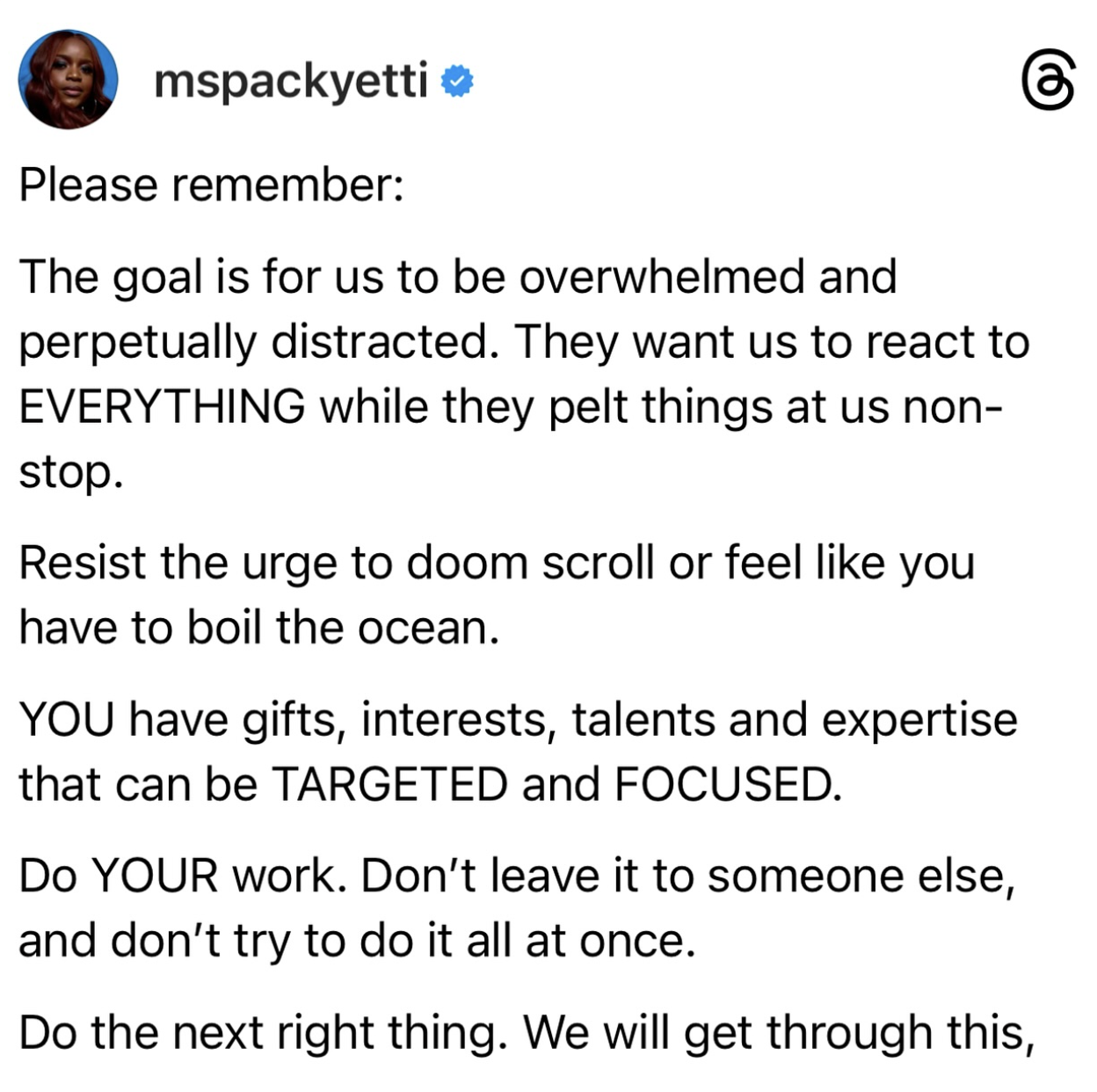
Unlearning the habit of remaining in a reactive state is something most of us can probably practice right now. What gifts, talents and expertise can you dial in to contribute to help others, especially those being villainized and attacked by the Trump administration?
I've also paid attention to Han's content on TikTok. She shares about how accesible mutual aid and community care can be and how becoming involved with our communities offline is imperative. Check out her content if you're wondering what you can do.
nourishing: I'm still making soup weekly and freezing portions in my Souper Cubes. One recent addition I've made is adding some high-protein foods from Costco into my rotation:
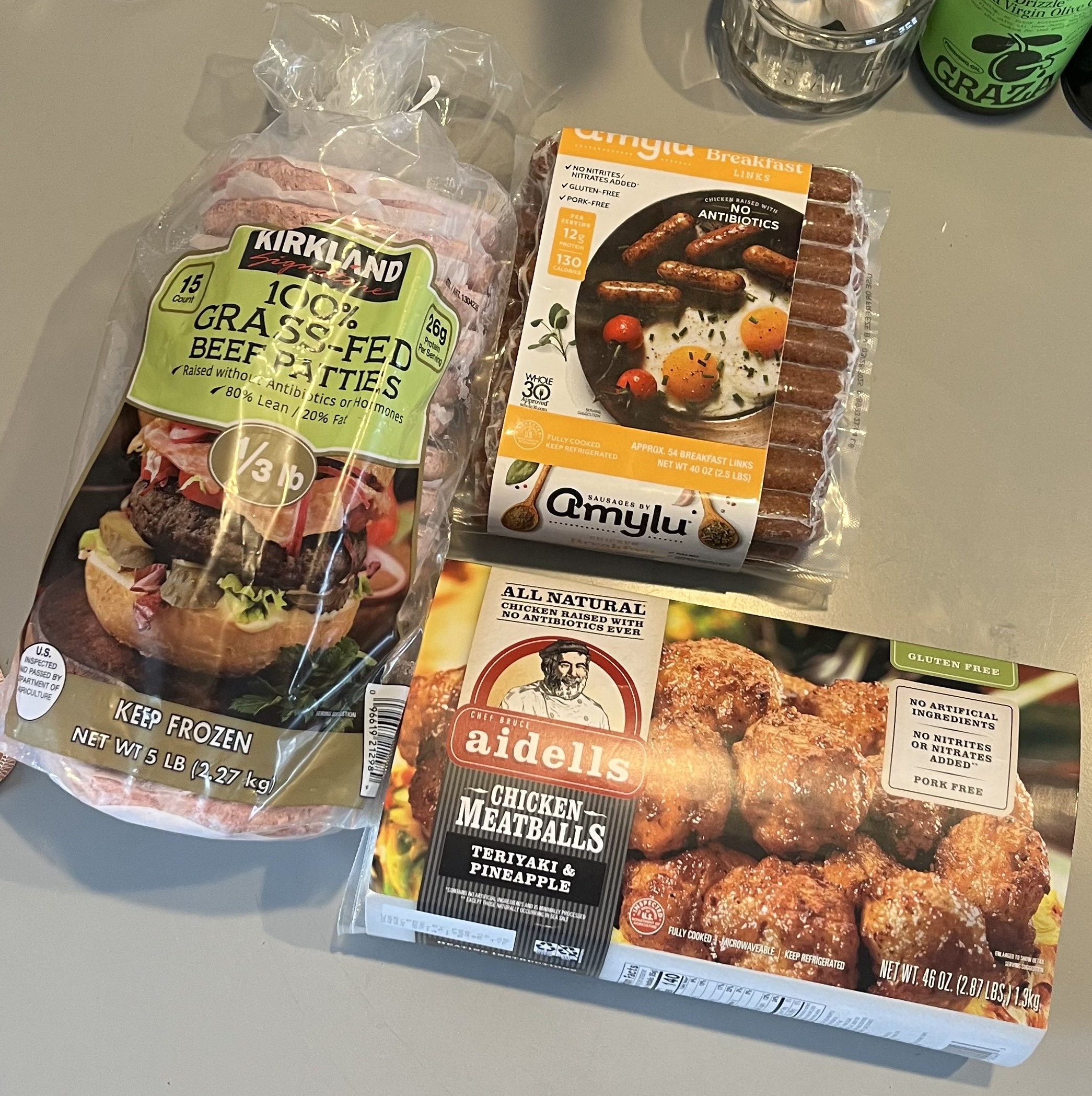
I was inspired by a few posts I saw about Costco finds, and I found 'em! I felt myself becoming burnt out on some of my go-tos, and these have helped a ton! Food burnout is normal, and simple swaps (especially foods like these that you can pop in the air fryer and add to dishes) can go a long way.
discovering: I received a Needoh Nice Cube and a Nodpod as part of my family secret santa gift exchange. And I LOVE both of them. The Needoh is a totally SILENT fidget I can take with me anywhere. It's been helping to keep me from clenching my jaw when I'm tense - big TMJ win. The Nodpod (basically a weighted blanket for your eyes) actually, truly, helps me drift off to sleep. It helps my husband too! Both are small additions to my routine with huge impact!!
improving: Three days ago, I had my first ski lesson with a professional instructor. I think I'm going to dedicate an entire post to this experience, but I'll give you the TL;DR here. I can't even tell you how intimidated I felt to 1) physically attend a ski lesson because I judge my skiing abilities harshly (even though my husband taught me how to ski two years ago and I have progressed immensely with his guidance) and 2) invest nearly $300 in a 2-hour lesson with someone I don't even know.I forced myself to book the lesson during a brief "you know what, hell yeah" moment. I was nearly sick with anxiety the morning before attending the lesson. And guess what?
THE LESSON WAS AMAZING! I learned exactly what I need to do to improve my skiing from having a skilled professional observe and guide me. I received validation I needed to keep pursuing progress. And the instructor was so kind!
And I also learned that sometimes, the lesson IS the lesson. Putting myself on the hook, investing in my own progress, asking for help, putting myself out there: I actually showed myself that I can commit to learning and bettering myself. And I know this may sound goofy because I am a coach that asks folks to trust me in doing the same. But the imposter syndrome and the "I'll just ask for help once I'm better at this" mindset was holding me back. I share this with you because I want you to know that if you want to progress with something, you have the means to invest in help, and you're ready to commit to improvement, just fucking do it.
nurturing: Morning walks with my husband, Mark, and my dog, Jerry have been particularly life-giving lately. I'm so grateful for them both, and quality time with them while getting my morning sunlight in beautiful Colorado is a privilege I'm thankful for each day.
giggling: Honestly, I'm laughing at myself. Failing forward might sound cringe, but each time I busted my ass on ice while skiing or lifted a weight that turned out to be way too heavy in the last week, I laughed it off and moved on. I love how failing can be so unserious, so helpful, and so totally neutral, all at the same time (if you let it be).
I'll leave you here. Thank you so much for being here and spending some of your time with me. Thanks for your grace as I get back into a rhythm with writing the lift to ground newsletter.
I always love hearing from you, so feel free to respond!
Much love always,
Sara

Responses